
Theatre Major
Bachelor of Fine ArtsOur B.F.A. program is designed for students eager to build broad expertise in developing and staging theatrical productions. At Texas A&M, you can do it all — you don’t have to specialize right away. Combine courses in performance, production and arts administration to find your niche, feed your curiosity, explore new interests and diversify your skills. Imagine yourself here — creating, collaborating, performing and building the theatre of the future.
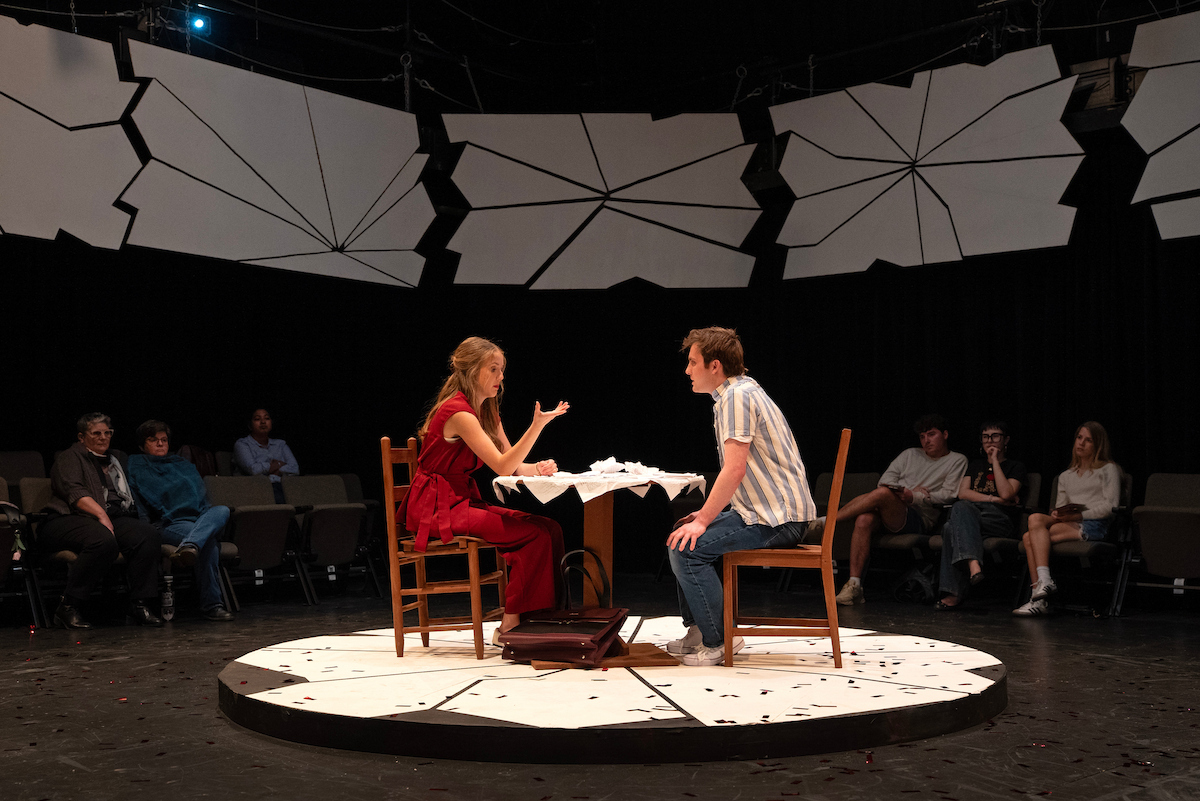
Degree Overview
We believe that great theatre-makers know a bit of everything. Our program offers a well-rounded foundation, so you’ll graduate ready for collaboration with shared language, creative approach and leadership skills.
You’ll prepare for careers onstage, backstage and offstage, training in collective creation and collaborative production, all rooted in an ethic of care. Our practice-based approach covers every facet of theatre-making: performance, design, production and arts leadership.
Areas of Emphasis
Our program covers:
- Performance: acting, voice, movement, playwriting and directing
- Design and Production: design and technology for sets, lighting, costumes and sound
- Arts Administration and Community Engagement: producing and archiving live performance, dramaturgy, theatre education and outreach
Pillars of the Theatre Major
Creating With Care
What would it look like to work in a healthy creative environment? Our program is built on principles of respect and safety for everyone — onstage and off. Every facet of our program focuses on communication and collaboration, preparing you to lead with respectful language in difficult conversations and to build trust-centered ensembles. Our foundational course, Creating With Care, introduces you to the growing field of intimacy coordination to ensure that you embark on your career with a commitment to making your workplaces safe and equitable. Our industry is constantly transforming, and your education here will prepare you to be a transformative agent in your future career.
Innovation
Want to create something brand new? In our program, you’ll devise original work with your peers, often starting with improvisation, or even your own research rather than a finished script. Our curriculum focuses on collaborative, ensemble-based creation of original work, de-centering traditional scripts to develop performances through improvisation, movement and methods of collective creation. Want to make a musical? You have the agency to make the art you want to see in the world, and we’ll help you build the skills you need to make it happen.
Interdisciplinarity
Develop a variety of skills so you can adapt to any project — or even start your own theatre company. The B.F.A. in Theatre takes a holistic approach to develop well-rounded professionals who have strong performance and production skills. You’ll develop skills as a collaborative deviser for the stage who can work across multiple production roles. Create connections with students across the College of Performance, Visualization and Fine Arts and integrate music, dance and media into the work you want to make from your own perspective.
Audition Requirements
An audition is required for admission to the Theatre major. All applicants (freshmen, transfer and change-of-major) will submit an audition to be reviewed by a committee of Theatre program faculty. Students must be accepted to the university and the Theatre program to declare a major in Theatre.
Audition RequirementsCurriculum
You’ll learn to create, stage and lead new and original theatrical works as a creative and independent theatre-maker. Our program offers focused instruction in performance and directing, design and production, arts administration, entrepreneurship and community engagement. At Texas A&M, theatre-makers develop global, cultural and social competencies to collaborate with diverse artists and communities. Through hands-on collaborative performance-making, students sharpen their empathy, active listening skills and critical inquiry, learning to leverage their artistic practice to engage real-world questions and address the challenges facing our society.
The four-year theatre undergraduate degree requires a minimum of 120 credit hours.
Degree Plan | 2026-2027 Catalog
Year 1 30 credit hours
Fall Semester – 15 credit hours
Introduction to Devised Theatre | PERF 103 | 3 credit hours
Overview of approaches to devising performance and collective creation in the U.S. and around the world; fundamentals of theatrical production.
Creating with Care | PVFA 111 | 3 credit hours
Foundations of care and respect in art making and creative practices; strategies for fostering inclusive and equitable performance works and workspaces; safety and consent in staging intimacy and combat on stage and screen.
Introduction to Stagecraft | THEA 112 | 3 credit hours
Foundations of theatrical production and collaboration; introduction to theatre technology including scenic construction, drafting, carpentry, lighting and rigging; scene shop and stage safety; use of equipment including hand tools and power tools.
Any Creative Arts University Core Course | 3 credit hours
Multiple classes could fulfill this requirement.
Any Life and Physical Sciences University Core Course | 3 credit hours
Multiple classes could fulfill this requirement.
Spring Semester – 15 credit hours
Acting I | THEA 110 | 3 credit hours
Acting I: Fundamentals. A Stanislavsky-based approach to the fundamentals of acting, which may include sensory exercises, relaxation, concentration, imagination, improvisation, character analysis and scene work.
Introduction to Theatrical Design | THEA 245 | 3 credit hours
Elements and principles of design for the theatre; role of the designer within the production team; theoretical and practical applications in the visual interpretation of plays.
Composition and Rhetoric | ENGL 104 | 3 credit hours
Focus on referential and persuasive researched essays through the development of analytical reading ability, critical thinking and library research skills.
Any Mathematics University Core Course | 3 credit hours
Multiple classes could fulfill this requirement.
General Elective | 3 credit hours
Multiple classes could fulfill this requirement.
Year 2 30 hours
Fall Semester – 15 credit hours
Decentering the Text | THEA 220 | 3 credit hours
Modes of authorship in theatre; introduction to script analysis techniques; approaches to collective creation, verbatim theatre and postdramatic theatre-making.
Performance Elective | 3 credit hours
Select from THEA 210; MUSC 235; DCED 240; DCED 242; DCED 306; PVFA 310; THEA 310; THEA 320; PERF 333; MUSC 335; MUSC 345; THEA 379; ENGL 385; THEA 390; DCED 400; DCED 402; PERF/FILM 402; PERF 407; THEA 410; PVFA 483
Design and Production Elective | 3 credit hours
Select from MUSC 203; THEA 250; THEA 255; THEA 307; THEA 345; THEA 355; THEA 360; THEA 392; THEA 435; PERF 446
Any Communication University Core Course | 3 credit hours
Multiple classes could fulfill this requirement.
Any American History University Core Course | 3 credit hours
Multiple classes could fulfill this requirement.
Spring Semester – 15 credit hours
Dramaturgy | THEA 300 | 3 credit hours
Exploration of literary, production and theoretical dramaturgy in a classroom setting; script analysis; theatre criticism; theories of theatre, research techniques and dramaturgy in the production process; advancing thought about the art form in all its complexity; research methods for theatre.
Performance History | 3 credit hours
Select from PERF 310; PERF 311; PERF 312
Arts Administration and Community Engagement Elective | 3 credit hours
Select from DCED 216; INST 222; PERF 223; PVFA 240; DCED 304; PERF 308; PERF 338; THEA 342; THEA 370; THEA 401; DCED 411; THEA 482
Any Mathematics University Core Course | 3 credit hours
Multiple classes could fulfill this requirement.
General Elective | 3 credit hours
Multiple classes could fulfill this requirement.
Year 3 30 credit hours
Fall Semester – 15 credit hours
Performance AND VISUAL Studies Seminar | 3 credit hours
Select from PERF 450; PERF 451; PERF 452; PERF 453; PERF 454; PERF/WGST 455; PERF 456; PERF 457; PERF 460; PERF 461
Design and Production Elective | 3 credit hours
Select from MUSC 203; THEA 250; THEA 255; THEA 307; THEA 345; THEA 355; THEA 360; THEA 392; THEA 435; PERF 446
Performance Elective | 3 credit hours
Select from THEA 210; MUSC 235; DCED 240; DCED 242; DCED 306; PVFA 310; THEA 310; THEA 320; PERF 333; MUSC 335; MUSC 345; THEA 379; ENGL 385; THEA 390; DCED 400; DCED 402; PERF/FILM 402; PERF 407; THEA 410; PVFA 483
Any Life and Physical Sciences University Core Course | 3 credit hours
Multiple classes could fulfill this requirement.
General Elective | 3 credit hours
Multiple classes could fulfill this requirement.
Spring Semester – 15 credit hours
Creating Performance | PERF 303 | 3 credit hours
Live and mediated performance; techniques and skills for performance; practical experience; discussion and critical analysis of performance; strategies for devising performance.
Arts Administration and Community Engagement Elective | 3 credit hours
Select from DCED 216; INST 222; PERF 223; PVFA 240; DCED 304; PERF 308; PERF 338; THEA 342; THEA 370; THEA 401; DCED 411; THEA 482
Any Language, Philosophy and Culture University Core Course | 3 credit hours
Multiple classes could fulfill this requirement.
American National Government | POLS 206 | 3 credit hours
Survey of American national government, politics, and constitutional development.
GENERAL ELECTIVE | 3 CREDIT HOURS
Multiple classes could fulfill this requirement.
Year 4 30 credit hours
Fall Semester – 15 credit hours
Devised Theatre Studio | THEA 304 | 3 credit hours
Advanced theory and practice of conceiving, developing, rehearsing and staging live and mediated devised theatrical performance; investigation of structures for collaborative creation; advanced techniques and skills for devising theatre; discussion and critical analysis of devised theatre. May be repeated two times for credit. Prerequisites: Grade of C or better in PERF 303.
Design and Production Elective | 3 credit hours
Select from MUSC 203; THEA 250; THEA 255; THEA 307; THEA 345; THEA 355; THEA 360; THEA 392; THEA 435; PERF 446
Performance Elective | 3 credit hours
Select from THEA 210; MUSC 235; DCED 240; DCED 242; DCED 306; PVFA 310; THEA 310; THEA 320; PERF 333; MUSC 335; MUSC 345; THEA 379; ENGL 385; THEA 390; DCED 400; DCED 402; PERF/FILM 402; PERF 407; THEA 410; PVFA 483
State and Local Government | POLS 207 | 3 credit hours
Survey of state and local government and politics with special reference to the constitution and politics of Texas.
Any American History University Core Course | 3 credit hours
Multiple classes could fulfill this requirement.
Spring Semester – 15 credit hours
Capstone | THEA 441 | 3 credit hours
Capstone senior project on an individually chosen research topic, presentation of a performance or interdisciplinary project; major writing and oral communication components. Prerequisites: Theatre major; completion of all Theatre coursework or taken concurrently with this course; approval of instructor, advisor and program director.
Any Social and Behavioral Sciences University Core Course | 3 credit hours
Multiple classes could fulfill this requirement.
Any Life and Physical Sciences University Core Course | 3 credit hours
Multiple classes could fulfill this requirement.
General Elective | 3 credit hours
Multiple classes could fulfill this requirement.
General Elective | 3 credit hours
Multiple classes could fulfill this requirement.
Customize Your Degree
Want to add music, dance or art to your degree? Theatre majors have 18 hours of general electives to personalize their experience. Tailor your degree to your artistic interests and ultimate career goals, and collaborate with artists in other fields. Consider using your electives toward a minor, such as:
Career Opportunities
Where can theatre take you? Our graduates become actors, directors, designers, producers, educators, writers and more. Theatre teaches you to collaborate, communicate, take initiative, creatively solve problems and connect with people. These are skills that all employers value. A theatre degree prepares you to become a skilled professional and entrepreneur ready for a surprising variety of career paths in a changing and dynamic world:
- Theatre and live performance
- Film and television
- Teaching and arts education
- Concerts, festivals and live entertainment
- Themed entertainment and tourism industries (theme parks, cruise lines, immersive experiences)
- Applied theatre (shape society using theatrical skills, for example, to help train doctors, federal investigators and lawyers, or to engage lawmakers)
- Community arts (working with schools, senior citizens, people with disabilities)
- Drama therapy
- Arts management
- Museums, heritage sites and historical reenactment
Potential Career Paths in Theatre
- Producer
- Director
- Performer/Actor
- Dramaturg
- Stage manager
- Intimacy coordinator
- Stage combat choreographer
- Scenic designer
- Costume designer
- Lighting designer
- Sound designer
- Theatre educator/teacher
- Theatre facilities manager
- Drama therapist
- Arts and health administrator
- Set construction/carpenter
- Prop maker
- Stage makeup designer
- Box office manager
- Voice coach
Related Minors
Considering a career in theatre education? Register for the AggieTEACH SEED minor to get the training you need to become a teacher, and graduate certified to teach secondary education theatre in Texas.
You can add theatrical creativity to your tool kit no matter your major. The Devised Theatre minor is an abridged version of the B.F.A. degree, focusing on the skills to develop and stage original theatrical works.
This minor is designed to meet the growing demand for artificial intelligence integration in artistic practice, equipping students with the skills to incorporate AI into visual arts, dance, theatre, interactive media and music. The program provides a comprehensive education on the use of AI tools, emphasizing critical decision-making, ethical considerations and the social implications of AI.
FAQ About the Theatre Degree
How will the program prepare me for a career?
A Theatre degree prepares you to become a skilled professional and entrepreneur who can work across different areas of theatrical production, as well as for multiple career paths in a changing and dynamic world.
There are many resources available to you at Texas A&M that can help you identify and prepare for your future career. The best resource is the TAMU Career Center, which houses mentors experienced with Theatre majors.
How do I declare a major in Theatre?
To declare a major in Theatre, please contact your academic advisor.
How much does it cost to attend?
The cost to attend varies depending on a variety of factors, including semester of admission, student type, how many hours you take per semester, and rate type. Use the Texas A&M Tuition Calculator to get the best estimate of your tuition cost per semester.
Additional costs to consider include course materials, housing, meal plans, parking and fees.
What financial aid and scholarships are available to students?
Numerous scholarships and financial aid are available through Texas A&M University and the College of Performance, Visualization & Fine Arts. Incoming freshmen applicants are considered for university scholarships through the ApplyTexas Application or the Coalition Application. Continuing students can apply for additional scholarships through the University Scholarship Application for Continuing Students. For more information about university scholarships, visit scholarships.tamu.edu.
Who can I go to with questions?
For more information about the B.F.A. in Theatre, please contact Professor Rayna Dexter at rdexter@tamu.edu.